Kate Brim Adds Two More World Titles and Keeps Redefining What’s Possible
15 September 2026
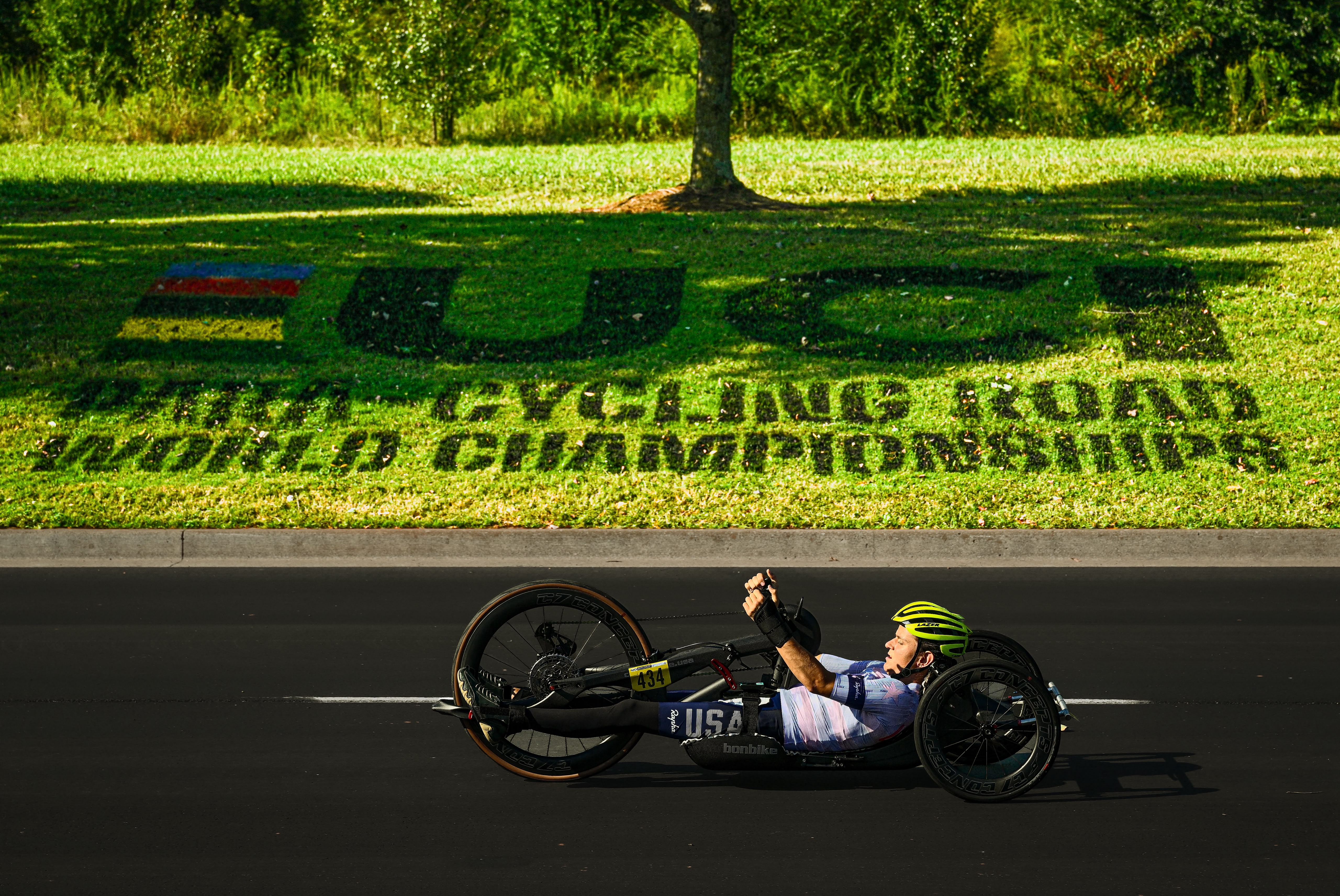
Kate Brim landed home at 3 a.m. She’d left the 2026 UCI Para-Cycling Road World Championships – held on U.S. soil, in Huntsville – with two more rainbow jerseys, bringing her career total to six world championship titles. Twenty-four hours later, still catching her breath, she was on a call with the Team Novo Nordisk media team.
“It’s been pretty hectic,” Brim said. “I think that was like the fastest a trip had ever gone by for me.”
She’d won both the time trial and the road race in her category. But behind the celebration was a story that, for Brim, has become almost routine: another obstacle, cleared just in time to compete.
A Warning Sign the Morning Of
Days before the road race, Brim noticed redness around her central line – the port in her chest through which she receives nearly all of her nutrition and medication. She and her medical team hoped it was irritation, a byproduct of travel and the friction of racing.
It wasn’t. By race morning, the decision was hers to make if she’d take the start line.
“We were hoping that it was just skin irritation,” Brim said. “But then it just kept getting redder and redder, and it was not looking good.”
After consultations with her medical team, she raced anyway. She won. Then she went straight to the emergency room, where doctors confirmed the infection and sent her home only hours before she got on the flight home.
It’s the kind of split-second calculation that doesn’t show up in a results sheet, but it’s become part of Brim’s normal.
Racing on TPN
The central line itself tells a longer story. Nearly two years ago, Brim was diagnosed with gastroparesis and fitted with a feeding tube. When that led to serious malnutrition and a severe hyperglycemic episode at a previous World Championships, her medical team moved her onto total parenteral nutrition (TPN).
She was told the average life expectancy on TPN was three to five years. She was 26.
“That was a big kick to the gut,” Brim said. “The stubborn part of me was like, okay, well, if that’s going to be the case, I want to make sure I’m fulfilling every dream and goal I possibly can with my situation, whatever that may look like.”
What followed wasn’t resignation – it was recalibration. With the support of her care team and connections to others living on TPN, Brim has found her footing. “It’s crazy to say this,” she said, “but I’ve felt the healthiest that I’ve ever felt.”
Managing the diabetes side of that equation has meant relearning her own body from scratch. Insulin delivered through the TPN bag is, in her words, “a nightmare” to control. She’s since transitioned back to an insulin pump, relying on basal rate adjustments and reactive corrections rather than the simple pre-bolus routine most people with Type 1 diabetes use. On the bike – where her gastrointestinal symptoms happen to ease – she’s found a fragile system of gels that mostly works, while hydration remains a genuine engineering problem: the dextrose in her feeds tends to clog the valve on her hydration system mid-race.
None of it is simple. All of it, this season, added up to two more world titles.
Ask Brim why she keeps going, and the answer isn’t about medals.
“I have always said I’m not racing for performance,” she said. “I am racing for showing myself what I’m truly capable of, and showing others what is truly possible.”
That mission showed up literally on the podium in Huntsville. In the month leading into Worlds, Brim taught herself loom beading and handmade 26 bracelets in Ukrainian colors – one for every rider who made the podium in her road race category – a nod to her own birthplace and to what it takes to reach that stage.
“It turned into a project for me for, you know, my whole mission and message,” she said. “People are chasing their biggest dreams and ambitions with setbacks, successes, hard times, failures – but they’ve made it to this big stage.”
From Ukraine to the Rainbow Jersey
Brim was adopted from Donetsk, Ukraine at four and a half and grew up in a small town in Michigan, close to home and to her community. A routine back surgery at 19 changed everything: a blood clot traveled up her spinal canal and damaged her C4 vertebra, leaving her paralyzed.
“That surgery was supposed to be outpatient, go home the same day,” she said. “And then you wake up and you’re laid flat on a bed, tons of doctors over your face trying to tell you what’s going on. It was quite alarming.”
It was at a rehabilitation hospital that she found hand cycling and wheelchair rugby – sports that gave her back a sense of control. “It really helped me in my recovery,” she said, “in the sense of showing me what I’m capable of.” Her first Para-cycling race led to an invitation to the 2022 World Championships in Canada, where she won her first world titles. She moved to the U.S. Paralympic Training Center shortly after, and has been there for almost four years – a stretch that’s since included a Paralympic gold in the time trial and bronze in the team relay in Paris.
Her Type 1 diabetes diagnosis came a few years after her spinal injury, discovered after she collapsed at a spinal-cord-injury camp – initially dismissed as heat exhaustion before a glucose reading near 1,000mg/dL told a different story.
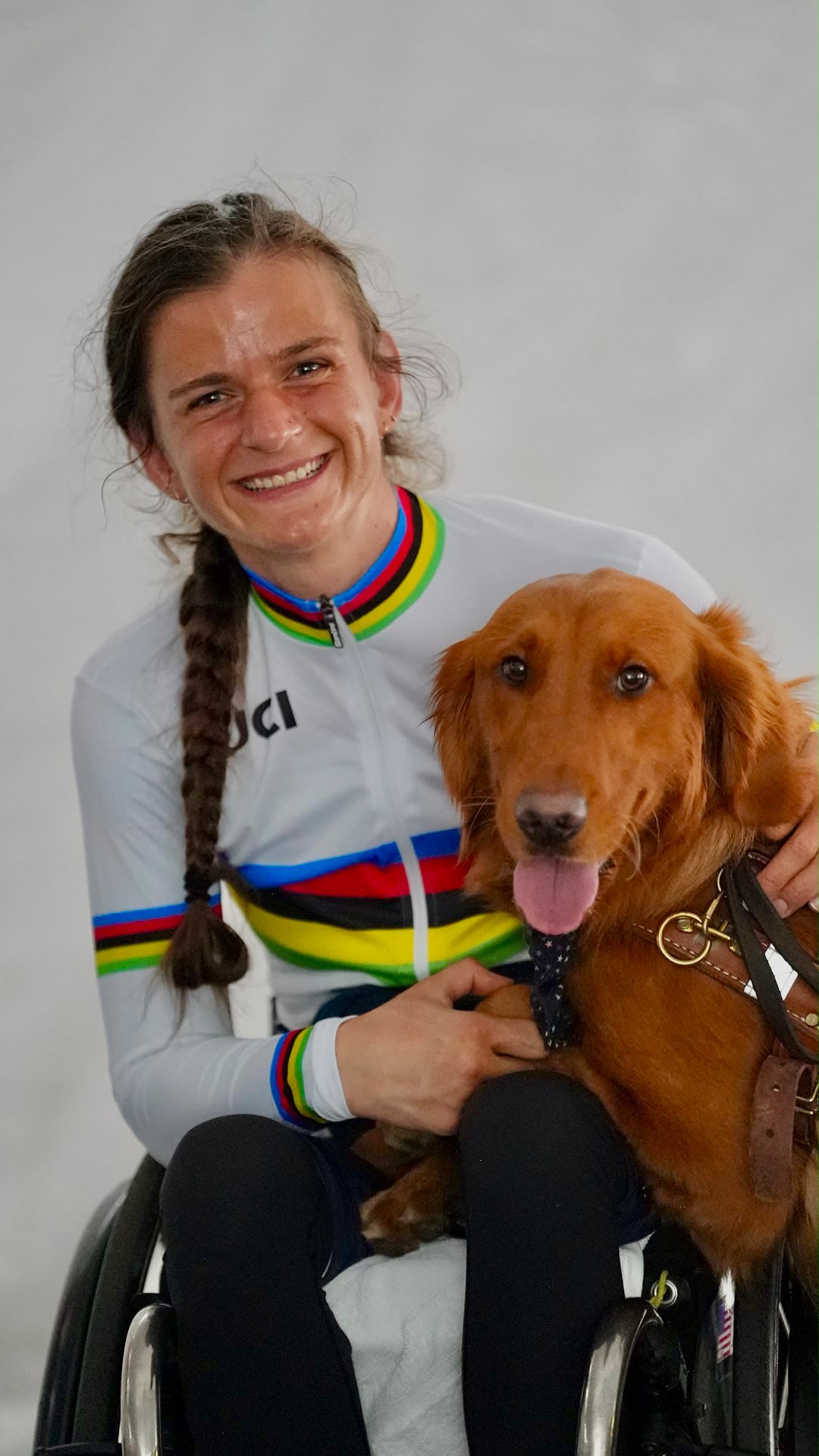
Brim lives independently, a milestone she says took years to reach. This past April, after nearly three years of deliberation, she added a diabetes alert dog, Sabako, to her team – a decision made urgent after a low blood sugar episode landed her in the ICU in Belgium.
Because of her spinal cord injury, Brim can’t always feel her highs or lows. Sabako often alerts her before her continuous glucose monitor does.
“His nose is so smart,” she said. “There’s been times where the CGM says I’m normal and I’m actually not, and he’s alerting me.” She worked closely with his trainer to make sure his alert style matched her needs as a wheelchair user – gentle, not startling. “He’s the gentlest little soul,” she said. “But so sweet, and so gentle… he and I have just created that bond.”
The Team Behind the Team
Asked how she keeps absorbing setback after setback, Brim doesn’t pretend it’s easy.
“I actually just recently asked myself that,” she said. “It feels like almost every single trip I do, I’m having something come up.” Weekly blood work. Weekly medication deliveries that have to be scheduled and met in person. A body that doesn’t always tell her the truth about her own glucose.
What keeps her going, she said, isn’t the podium – it’s everyone standing behind it. “The biggest thing, something I’ve leaned on hugely, is the team behind the team,” she said. “Everyone around me – supporters, medical staff, mechanics, friends, family, my sponsors. That is what keeps reminding me why I do what I do.”
Six world championship titles in, Kate Brim isn’t done recalibrating what’s possible for herself, or for anyone watching who needs the reminder.